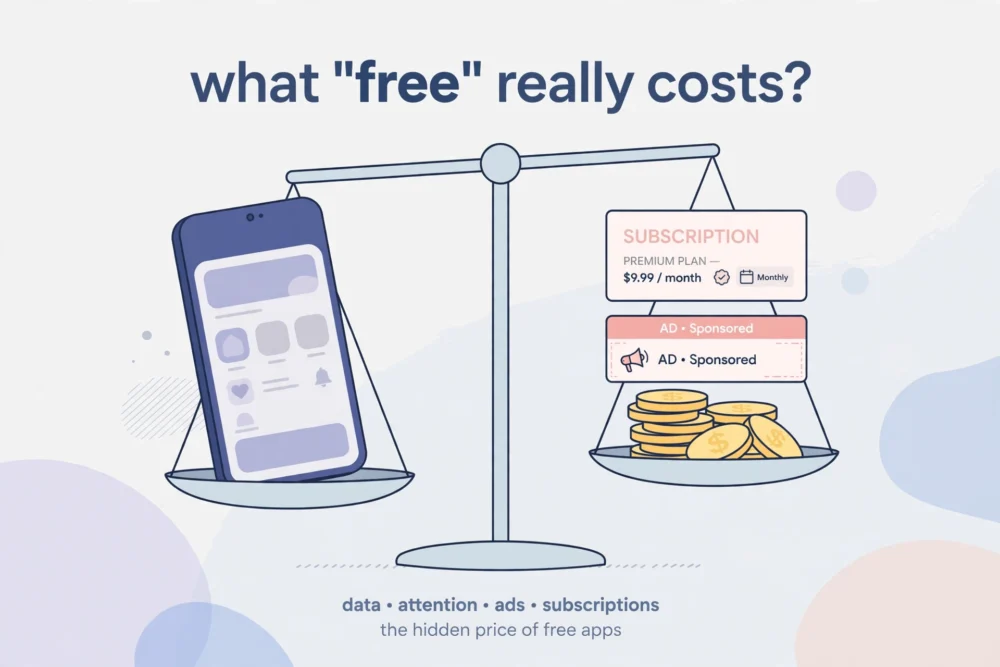
**Quick answer:** Free apps make money mainly through advertising, optional subscriptions, in-app purchases, and sometimes selling aggregated data insights. You are not usually paying cash, but you may pay with attention, with optional upgrades, or with personal data. Understanding which model an app uses tells you what the app is really optimizing for — and whether it deserves space on your phone.
## The Four Ways Free Apps Earn Money
### 1. Advertising
The most common model. The app shows banner ads, video ads, or sponsored content, and advertisers pay the developer for your attention. Social, news, gaming, and utility apps commonly use this model.
What it costs you: time and attention, plus some battery and data use. Ads can also make an app feel cluttered and slow. The app’s incentive is to keep you scrolling, because more time in the app means more ads shown.
### 2. In-App Purchases
The app itself is free, but extras cost money: extra levels in a game, filters in a photo app, premium features in a fitness app. This model is honest when the free version is genuinely usable and purchases are truly optional.
What it costs you: money, but only if you choose to spend it. Watch for apps where the free version is deliberately frustrating — endless waiting, heavy limits — because the design goal there is to push you toward paying rather than to serve you well.
### 3. Freemium Subscriptions
The app offers a basic free version and a paid subscription for the full version. This is the model behind most productivity, fitness, photo, and music apps. It is usually the healthiest model for users, because the developer earns money from people who value the app enough to pay, not from advertisers.
What it costs you: a recurring fee if you subscribe. The trap is forgetting subscriptions. Check your app store subscriptions every few months and cancel the ones you no longer use.
### 4. Data and Insights
Some apps earn money from data: aggregated usage statistics, anonymized trends, or, in the worst cases, personal information shared with third parties. Reputable developers limit this to anonymous analytics that improve the app. Less reputable ones sell detailed user profiles.
What it costs you: privacy. This is the model to watch most carefully, because the cost is invisible. A free app that asks for contacts, location, and photos it clearly does not need is a warning sign.
## How to Tell Which Model an App Uses
Read the app store listing before installing. Look for “In-App Purchases” and “Contains Ads” labels — both stores show these clearly. Then check the privacy section: it lists what data the app collects and whether it is linked to you or used for tracking. An app that collects your location, contacts, and browsing history for a simple calculator has no good reason to do so.
## The Real Cost of “Free”
Free is rarely free in the full sense. The honest question is not whether you pay, but what you pay with:
– **Attention** — ads and infinite feeds cost time.
– **Money** — purchases and subscriptions cost cash, sometimes forgotten monthly.
– **Privacy** — data collection costs control over your information.
An app is a good deal when what you pay matches what you get. A free, ad-supported weather app is a fair trade. A free flashlight app demanding your contacts and location is not.
## Protecting Yourself Without Giving Up Free Apps
– Review app permissions after installing, and remove any that the app does not need to function.
– Turn off personalized ads in your phone’s privacy settings if you prefer generic ads.
– Audit subscriptions quarterly — cancel anything unused.
– Prefer apps with clear business models: a subscription you understand beats a vague “free” app whose income source is a mystery.
– Read the privacy label, not just the star rating. A 4.8-star app can still harvest data aggressively.
## Frequently Asked Questions
### Why are so many apps free?
Because free removes the barrier to installing, which builds a large user base quickly. Developers then earn from a fraction of those users through ads, purchases, or subscriptions. A free app with millions of users can earn more than a paid app with thousands.
### Do free apps sell my personal information?
Some do, and some do not. Reputable apps limit data use to anonymous analytics, while others share detailed profiles with advertisers and data brokers. Check the app store privacy label before installing, and avoid apps that collect data unrelated to their function.
### Is a paid app always better than a free one?
Not always. Many free apps are excellent, and some paid apps are poor. What matters is the business model and the developer’s reputation. A well-made free app with a clear subscription option is often better than a paid app with no ongoing development.
### How can I check what data an app collects?
On both iPhone and Android, the app store listing includes a privacy section listing collected data types and whether they are linked to you or used for tracking. Your phone’s privacy settings also show which permissions each installed app currently holds.